The post What Can You Do When Your Insurance Claim is Denied? appeared first on Wirsig Matheos is now part of McQuarrie.
]]>If you or a loved one are ever injured, chances are you expect to rely on your insurance to protect you and cover medical expenses, potential lost wages, or injury rehabilitation services. However, what happens if your insurance claim is denied? When your insurance claim has been denied, or if your benefits terminated before you are able to return to work, the consequences to you and your family can be devastating.
If your insurance claim has been denied there are three steps you can take immediately that will help you resolve the situation:
1 – Review Your Insurance Policy to Confirm Coverage, Exclusions, and Limitations
The first step after your insurance claim is denied is to read your insurance policy. Your insurance policy will list what is covered, and will also include any limitations or exclusions. If you speak with a Wirsig Matheos disability claim lawyer, they will also want to read your insurance policy to determine whether the facts in your case are covered. They will best be able to interpret the terms of the policy to confirm what conditions must be met or if there are any interpretation issues to address.
The policy should also include whether there is an internal appeals process that you need to follow to challenge the denial of your claim. Often these processes have strict time limits so be sure to check for time limits and don’t leave consulting a claims denial lawyer to the last minute.
2 – Speak to Your Insurance Company
If you’ve received a letter from your insurance company advising you on your benefits denial, and it is unclear why your claim was denied, don’t hesitate to call them to ask for a written explanation for the denial. The insurance company should be able to provide you with written reasons for the denial. Reasons could range from no proof of disability to failure to be under the regular and appropriate care of a physician. Knowing why your claim was denied will help you and your disability claim lawyer decide what steps to take next. Those actions may include steps to appeal your insurance company’s decision through an internal appeals process (if there is one) or taking steps to launch an external appeal.
3 – Speak to a Disability Claim Lawyer
Unfortunately, insurance companies do deny insurance benefits in circumstances where it is not appropriate to do so. There are disability claims that are commonly denied, but it’s important to remember that even in situations where the insurance company permits you to appeal the decision, it is still important to seek legal advice from a disability claim lawyer. You have a limited time within which to take legal action, depending on the facts of your case. Speaking with an experienced lawyer can make the difference between getting a settlement or losing your right to challenge the insurance company’s decision.
At Wirsig Matheos, we have over 60 years of combined legal experience dedicated to litigating insurance claims, including denials of short and long term disability benefits, life insurance and critical illness claims. If your claim has been denied, contact us and our lawyers can offer guidance on your options and how to resolve your situation efficiently.
The post What Can You Do When Your Insurance Claim is Denied? appeared first on Wirsig Matheos is now part of McQuarrie.
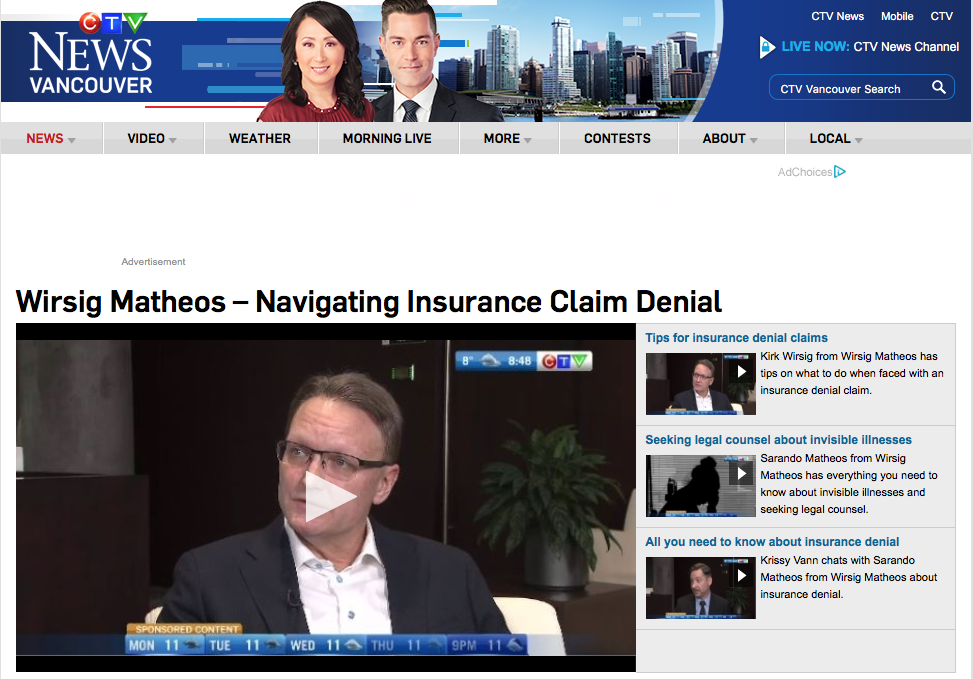
]]>The post Wirsig Matheos Interview on CTV Morning Live appeared first on Wirsig Matheos is now part of McQuarrie.
]]>- Disability claims are not the same as personal injury claims;
- Having a disability and meeting the criteria to have your claim approved are separate things;
- The clock is ticking (limitation periods apply); and
- You can consult a lawyer free of charge
You can find the full article as well as the interview with Kirk Wirsig on CTV’s website.
The post Wirsig Matheos Interview on CTV Morning Live appeared first on Wirsig Matheos is now part of McQuarrie.
]]>The post What Can You Do If Your Insurance Claim Has Been Denied? appeared first on Wirsig Matheos is now part of McQuarrie.
]]>If you or a loved one are ever injured, chances are you expect to rely on your insurance to protect you and cover medical expenses, potential lost wages, or injury rehabilitation services. However, what happens if your insurance claim is denied? When your insurance claim has been denied, or if your benefits terminated before you are able to return to work, the consequences to you and your family can be devastating.
If your insurance claim has been denied there are three steps you can take immediately that will help you resolve the situation:
1 – Review Your Insurance Policy to Confirm Coverage, Exclusions, and Limitations
The first step after your insurance claim is denied is to read your insurance policy. Your insurance policy will list what is covered, and will also include any limitations or exclusions. If you speak with a Wirsig Matheos disability claim lawyer, they will also want to read your insurance policy to determine whether the facts in your case are covered. They will best be able to interpret the terms of the policy to confirm what conditions must be met or if there are any interpretation issues to address.
The policy should also include whether there is an internal appeals process that you need to follow to challenge the denial of your claim. Often these processes have strict time limits so be sure to check for time limits and don’t leave consulting a claims denial lawyer to the last minute.
2 – Speak to Your Insurance Company
If you’ve received a letter from your insurance company advising you on your benefits denial, and it is unclear why your claim was denied, don’t hesitate to call them to ask for a written explanation for the denial. The insurance company should be able to provide you with written reasons for the denial. Reasons could range from no proof of disability to failure to be under the regular and appropriate care of a physician. Knowing why your claim was denied will help you and your disability claim lawyer decide what steps to take next. Those actions may include steps to appeal your insurance company’s decision through an internal appeals process (if there is one) or taking steps to launch an external appeal.
3 – Speak to a Disability Claim Lawyer
Unfortunately, insurance companies do deny insurance benefits in circumstances where it is not appropriate to do so. There are disability claims that are commonly denied, but it’s important to remember that even in situations where the insurance company permits you to appeal the decision, it is still important to seek legal advice from a disability claim lawyer. You have a limited time within which to take legal action, depending on the facts of your case. Speaking with an experienced lawyer can make the difference between getting a settlement or losing your right to challenge the insurance company’s decision.
At Wirsig Matheos, we have over 60 years of combined legal experience dedicated to litigating insurance claims, including denials of short and long term disability benefits, life insurance and critical illness claims. If your claim has been denied, contact us and our lawyers can offer guidance on your options and how to resolve your situation efficiently.
The post What Can You Do If Your Insurance Claim Has Been Denied? appeared first on Wirsig Matheos is now part of McQuarrie.
]]>The post ICBC Claims: Part 7 No-Fault Secondary Benefits appeared first on Wirsig Matheos is now part of McQuarrie.
]]>ICBC Part 7 No-Fault Benefits are known as secondary benefits. This means that they are intended to make up the shortfall after you have used the insurance coverage that you already have. Therefore, to access Part 7 benefits, you must first submit expenses for medical care and any disability plan coverage that you have. The balance of any expenses that are not covered by the disability plan can be submitted to ICBC for shortfall secondary coverage.
For example, you must apply for primary disability coverage from any disability plans available to you through your employer or your spouse’s employment. If there is no other disability plan open to you, then you would need to apply for Employment Insurance Sick Benefits or WorkSafeBC benefits, if you were at work at the time you were injured.
Deadlines for Challenging a Denial of Benefits
If your disability coverage is denied by a primary insurer, there may be several reasons for the denial. Your disability coverage may be individual, a private plan, or a group plan or policy, paid as part of your employment package. In any of these cases, do not delay in taking steps to challenge a denial as there are mandatory deadlines to seek legal recourse. If you miss them, you may be out of luck.
What Happens if I’m Working and I’m Injured in a Motor Vehicle Accident?
If you were working at the time of the accident, ICBC does not provide ICBC Accident Benefits because you are entitled to WorkSafeBC coverage even if you decide not to make a claim with them as the primary insurer. The one exception is when ICBC’s coverage supplements shortfalls not covered by WorkSafeBC. For example, if you need certain equipment, such as a medically necessary vehicle, as required due to your accident that is not covered by WCB but is covered by ICBC.
What is Subrogation for Primary Coverage Insurance Companies?
Section 84 of The Insurance (Vehicle) Act regulates the right of subrogation in a motor vehicle accident with ICBC. If you’re injured in a motor vehicle accident, you may have medical and disability coverage through workplace benefits. Often these benefit policies contain provisions that require the claimant to repay benefits if they recover damages from an at-fault third party.
Subrogation is a contractual right where insurance companies get reimbursed by the at-fault third party for payments made. The purpose of subrogation is to ensure that costs are applied to the appropriate party, and they are not paid twice to the claimant.
Can ICBC Pay Net Wage Loss After Deducting Disability Benefits?
However, ICBC is not allowed to deduct disability benefits if you pay all or part of the premiums of your private disability insurance plan. If there is a right of subrogation or repayment on the part of the insurance company, then ICBC cannot deduct the amount of the disability benefit you received from your claim.
For a disability plan through your employer, ICBC cannot deduct the disability benefits paid to you either. For example, if your net wage loss is $8,000 and you were paid $6,000 in disability benefits, ICBC does not pay you $6,000. They must pay you $8,000.
Should You Sign a Reimbursement Agreement with Your Employer (short answer, No)
Your employer or insurance company may want you to sign a reimbursement agreement. Be careful here as the employer or insurer may be using the reimbursement agreement to alter the employment contract or insurance policy. Review the employment contract or insurance policy and compare the language to the reimbursement agreement. If there is no language in the insurance policy or employment contract that speaks to a right of subrogation then common law rights prevail. At common law, the right of subrogation only arises after full indemnification (you recover 100% of your loss). Meaning, if you have to pay a legal fee you are not technically “made whole” and the right of subrogation (meaning repayment of employment or insurance benefit) may not arise. This can be altered by contractual terms. A reimbursement agreement is a contract and by signing it you may be creating an obligation that otherwise did not exist. However, most contracts, but not all, allow you to deduct legal fees when the right of subrogation arises.
Even where the right of subrogation is a contractual term, you may not be required to pay back the entire amount of disability benefits when you do not receive 100% recovery from the settlement. For example, if you are found to be partly responsible for the accident and recover only a portion of your loss, you may be able to limit repayment on a pro-rated basis. Again, it will depend on the wording of the contract.
If there is an issue in the ICBC claim that prevents you from recovering 100% of your damages, such as litigation, an intervening event (like a second accident), a pre-existing health condition, liability, your employer or insurance company may or may not be entitled to 100% recovery. That is why reviewing the contractual wording of the policy/employment contract and reimbursement agreement is critical.
It’s important to talk to a lawyer experienced in challenging disability claim denials if your employer or insurance company is asking you to sign a reimbursement agreement. Our lawyers can offer guidance on how signing a reimbursement agreement can impact your case.
The post ICBC Claims: Part 7 No-Fault Secondary Benefits appeared first on Wirsig Matheos is now part of McQuarrie.
]]>The post Disability Benefits and Critical Illness Insurance for Entrepreneurs appeared first on Wirsig Matheos is now part of McQuarrie.
]]>There are tax and other advantages to self-employment, but creating a safety net of disability and critical illness benefits for you and your family is necessary. If you are self-employed, these types of insurance are critical for financial survival.
As a small business owners if you became disabled or critically ill for a long time, it could financially devastate your business. Disability insurance for self-employed individuals ensures a monthly income while critical illness insurance provides a lump sum benefit after a set period (usually called a waiting period).
Which Policy Covers What? Health, Disability and Critical Illness
In addition to self-employed disability and critical illness insurance, there are extended health insurance plans that can help pay for medical and dental costs not covered by your provincial government health insurance (MSP). They can help provide protection against potentially costly, unforeseen health care expenses.
There are two types of extended health insurance to choose from: Health Spending Accounts (HSA) for more basic coverage and the more traditional Group Health Insurance plans that include coverage coverage for catastrophic (more serious) events.
In the event you suffer a disability or critical illness, it is important to know which insurance policy can cover you for partial income replacement, lump sum benefits or coverage for health expenses.
What is Self-Employed Disability Insurance?
When an unexpected accident happens and you’re unable to work, a self-employed disability policy will provide some income replacement, usually expressed as a percentage of your average monthly earnings. If you’re self-employed, you can buy self-employed disability insurance. The disability coverage also includes a cost-of-living benefit, which means the benefit increases to cover inflation during the disability. The taxability on this income depends on how the premiums are paid or structured. If the premiums are paid through a professional corporation, the benefits may be taxable in your hands. If the premiums are paid personally, the benefit may not be taxable. It is important that you seek the advice of a broker and accountant on how best to set up the coverage.
Why Self-Employed Disability Claims are Often Denied? The Importance of Knowing What Time Limits Apply.
Time limits are not the same for every disability policy and each circumstance is unique. Therefore, it is essential to get legal advice to know what time limits apply in your particular disability circumstance.
There are six reasons why disability claims are denied. Self-employed disability claim cases are often denied for lack of medical evidence. Our disability claim lawyers have successfully resolved these denied claims by producing medical evidence required to prove the disability defined under the policy
What is Critical Illness Insurance Coverage?
One in four Canadians will suffer a critical illness by age 65, and the costs related to critical illness continue to rise. Critical illness insurance is designed to protect policyholders who become critically ill or injured. If you are self-employed, critical illness benefits can be crucial to your financial survival.
Critical illness insurance is a fairly new product popular with self-employed Canadians. The policy provides a lump-sum payout from $50,000 up to $2 million dollars, depending on your coverage, if you’re diagnosed with one of the conditions under the policy. These include various forms of cancer, heart ailments, chronic diseases and other terminal illnesses listed in the policy. Therefore, it’s important to read the types of critical illness and the definitions of each in the policy document itself.
Why Do Self-Employed Critical Illness Claims Get Denied?
Even if you choose the correct Total Permanent Disability (TPD) if you are unable to work as defined in the policy, your critical illness insurance claim can be denied. It is very difficult to collect if the insurance company denies a claim, especially when the actual insured is critically ill, and not readily available to assist in the claim.
Your claim can be denied if you have a critical illness when you least expect it. That’s because insurance companies do not use the consumers’ definition of a critical illness or even the medical industry’s – they use their own definition as set under their policies.
Need Help With Self-Employed Disability or Critical Illness Claim Denied?
If you, or a family member, have become disabled and critically ill, and your insurance claims are being denied, you need expert advice from experienced disability and critical illness lawyers for a fair and equitable resolution of your claim.
In addition to meeting the definitions for insurance coverage, there are time limits for all critical illness and disability insurance claims. Any delay in proceeding may be subject to a deadline. You should not hesitate in starting your claim or obtaining legal advice to clarify both definitions and deadlines.
The post Disability Benefits and Critical Illness Insurance for Entrepreneurs appeared first on Wirsig Matheos is now part of McQuarrie.
]]>The post Why Was My Short Term Disability Claim Denied? appeared first on Wirsig Matheos is now part of McQuarrie.
]]>STD comprises of paid sick leave days, STD benefits from private insurance companies, Employment Insurance Sick Benefits, ICBC Part 7 Disability and WorkSafe BC benefits.
STD benefits from employers are indemnity plans administered through an insurance or health management company, while coverage from the other insurance programs are government regulated.
Short-term Disability Insurance Plans in BC
STD benefits begin payment after a specified number of days of the qualifying period, from the last day worked or after exhausting paid sick days. These short qualifying periods help reduce administration for claims of really short duration. Under an STD plan, disability is linked to the employee’s inability to perform any or all aspects of their occupation. Here are the general definitions for each of these short term disability insurance plans in BC:
1) Paid Sick Leave Days From Employer
You are required to use your accrued sick days first, up to a maximum set under the employment and insurance policy for sick leave if your employer provides this benefit. Paid sick days provide income protection when employees are ill, injured or caring for an ill family member. This may include a child, spouse, parent, parent-in law and same-sex domestic partner, depending on the policy.
2) Short Term Disability Benefits With Private Insurers
STD benefit payments begin after the last calendar day of sick leave coverage and continue for the duration of the disability to a maximum of the short term disability policy days. This STD provides salary protection for the employee or self-employed insured who is unable to work for a period of time due to a non-work related illness or disability. The private insurer will require certification of illness and disability from your physician or an independent medical examination (IME) with their own physician to verify the continued absence is legitimate.
Most short term disability policies from private insurers are up to two years in coverage. If the disability continues beyond this period, you could be qualified to apply for long term disability from either a private plan or Canada Pension Plan Long-term Disability.
3) Employment Insurance (EI) Sick Benefits
If you do not have a short term disability policy with a private insurer, you may apply at Employment Insurance (EI), a federal government program for temporary financial assistance to unemployed workers who are unable to work because of sickness, injury, or quarantine for medical reasons. If you qualify with the minimum insurable hours, and after the one-week waiting period as of 2016, you could be eligible to receive up to a maximum of 15 weeks of EI sickness benefits. You will need to obtain a medical certificate signed by your doctor or approved medical practitioner. Visit EI Sick Benefits for details.
4) Working, Injured and Disabled from a Motor Vehicle Accident?
ICBC Part 7 Benefits for short term disability are up to two years and is considered secondary coverage. Therefore, you must apply for primary disability coverage from any disability plans available to you through your employment or through a spouse’s employment. If there are no other disability plans, you will need to apply for Employment Insurance Sick Benefits or WorkSafeBC if applicable, before any shortfall coverage is available from ICBC Part 7 Benefits for short-term disability. Learn More About ICBC Claims and Primary vs. Secondary Coverage.
5) WorkSafe BC Disability Benefits from Work Injuries or Disease
If you have a work-related injury or disease, you will need to seek medical attention and report your injury to your employer. If you miss work or seek medical attention, you must report to The Workers’ Compensation Board of British Columbia aka WorkSafeBC, governed under the Workers Compensation Act. If you’re injured on the job and unable to work, call WorkSafeBC Teleclaim at 1.888.967.5377 to make a claim. (www.WorkSafeBC.com)
Please note that our firm does not represent people seeking to challenge WorkSafeBC disability claim denials.
Why Are Short term Disability Claims Denied?
Insurance companies often deny short term disability claims. There are six main reasons for these types of disability claim denials:
- Lack of Proof of Short Term Disability
- Changes in Medical or Functional Status
- Short Term Disability Denied After Time Limit
- Change of Definition for Own Occupation
- Exclusion for Pre-existing Conditions
- Failure to get Regular and Appropriate Physician Care
For the complete details on why disability claims are denied, visit six most common reasons for insurance companies to deny disability benefits.
Other Factors Influencing Short Term Disability Denials
Short term disability denials can also be related to application errors or insufficient evidence, while other denials occur because the situation does not meet the criteria for an STD claim. About two-thirds of all initial claims for disability benefits are denied, even seemingly credible ones. Here are some influencing factors for STD claim denials:
1) Private Investigation With Video Surveillance Reveals you Have Exaggerated your Injury or Illness
Video surveillance may be involved as long as it does not violate your personal privacy. Recordings are allowed as long as one party is aware of the recording. An invasion of your right to privacy may occur if an investigator is snooping around your home, knocking on your door under false pretences, i.e., pretending to be someone they are not, following you too closely in public places, or acting in an unreasonable or intrusive manner.
2) Your Social Media Posts
People usually post pictures of themselves in social situations smiling on social media. That’s because if you point a camera at someone, they are conditioned to smile – even if they are in pain. Also someone suffering emotional trauma may not want their friends and family to know how much they are suffering – so they choose to post only content that makes them appear well.
If social media posts are produced as evidence, the weight of those images for or against the claimant case is at the judge’s discretion. Both personal injury and short term disability cases are increasingly submitting evidence from social media, with the hope these posts will negate your claims. The takeaway is to be prudent about what you post on social media if you have been injured.
3) Report from Independent Medical Examiner that Contradicts your Injury or Illness
The insurance company will require you to attend an independent medical examination (IME) with their doctor. The doctor will evaluate your ability to function and respond physically and/or mentally to various tasks. They may make recommendations or restrictions on your ability to perform daily activities at home, work and recreation. The IME report is often used to confirm or deny short term disability benefits, other coverage and settlements.
4) Need Help With Your Short Term Disability Claim Denial?
You should not delay in getting legal advice to clarify definitions and deadlines for short term disability plans. Speak with one of our experienced lawyers if your STD claim is denied. You may be concerned about not having money to hire a lawyer, but we could represent you on a contingency for an agreed percentage. Learn more
The post Why Was My Short Term Disability Claim Denied? appeared first on Wirsig Matheos is now part of McQuarrie.
]]>The post Questions about Private Insurance Disability Claim Denials? appeared first on Wirsig Matheos is now part of McQuarrie.
]]>Martin will be answering questions related to disability claim denials by private insurance companies including:
- Long Term Disability (LTD)
- Short Term Disability (STD)
- Critical Illness
- Chronic and Complex Pain
Can’t make the event? You are welcome to contact us anytime for a free consultation.
The post Questions about Private Insurance Disability Claim Denials? appeared first on Wirsig Matheos is now part of McQuarrie.
]]>The post Upcoming Event: Martin Willemse Attending ME/FM Society of BC AGM September 24, 2016 appeared first on Wirsig Matheos is now part of McQuarrie.
]]>Please see the link below for further details on the meeting:
http://mefm.bc.ca/2016-annual-general-meeting/
The post Upcoming Event: Martin Willemse Attending ME/FM Society of BC AGM September 24, 2016 appeared first on Wirsig Matheos is now part of McQuarrie.
]]>The post Disability Insurance Claim Denials: The Insurer is not Always Right appeared first on Wirsig Matheos is now part of McQuarrie.
]]>The insurance company took the position that, while the insured’s heart stopped, it was not caused by a “heart attack”. The insurer defined “heart attack” as the heart stopping due to a blockage. Since the insured’s heart stopped for an inexplicable reason and not due to a blockage, he was deemed not covered. However, the medical community would describe what occurred here as a heart attack.
Don’t Automatically Assume the Insurer’s Interpretation is Correct
We have seen similar situations to that experienced by Mr. Glennie. An insurer will often deny a claim based on its interpretation of the terms of the policy. Many people simply accept the insurer’s interpretation because, after all, they are the ones administering the policy, and they are assumed to know best. However, it is imperative to review the master policy that sets out the terms of the contract. If there is another, equally compelling interpretation that would cause benefits to be paid, that is the interpretation that should prevail. Further, if there are two equally compelling interpretations, the legal concept of contra proferentem has been used as a tie breaker.
What is Contra Proferentum?
Contra proferentem means that where a term is ambiguous, the preferred meaning should be the one that works against the interests of the party who provided the wording. In the insurance context, it’s the insurer who is responsible for drafting standard form insurance contracts. Courts acknowledge that people entering insurance contracts (including disability insurance contracts) have no negotiating power over the terms of these contracts. They accept the terms or they don’t get coverage. Courts also assume that the drafters of these documents are well aware of any limitations or ambiguities and should not be allowed to take unfair advantage of this knowledge. Similarly, if an insurer did not choose its words carefully to avoid misunderstandings, it should not be allowed to benefit from that lack of care.
So, if the normal rules of contract interpretation do not clarify which interpretation was intended by the parties, the courts may apply contra proferentem to break the tie. Some exceptions may apply if the dispute involves an argument over coverage between two insurance companies.
We have resolved many cases favourably for our clients where we have applied this legal concept.
In Mr. Glennie’s case, this legal concept was not tested as the day following the news coverage of his case, the insurance company decided to “make an exception” and pay the claim.
What to do if Your Disability Claim is Denied
When your insurance claim is denied, seek legal advice from a lawyer that has specific expertise in insurance matters. It may make the difference between getting paid or, getting nothing. If you have a question about a disability claim denial call us at 604-583-2200 for a free, no obligation consultation.
The post Disability Insurance Claim Denials: The Insurer is not Always Right appeared first on Wirsig Matheos is now part of McQuarrie.
]]>The post Was your disability claim denied? appeared first on Wirsig Matheos is now part of McQuarrie.
]]>Anxiety
Anxiety is a general term for several disorders that cause nervousness, fear, apprehension, and worrying. These disorders affect how we feel and behave, and they can manifest real physical symptoms. Mild anxiety is vague and unsettling, while severe anxiety can be extremely debilitating, having a serious impact on daily life.
People often experience a general state of worry or fear before confronting something challenging such as a test, examination, recital, or interview. These feelings are easily justified and considered normal. Anxiety is considered a problem when symptoms interfere with a person’s ability to sleep or otherwise function. Generally speaking, anxiety occurs when a reaction is out of proportion with what might be normally expected in a situation.
Depression
Depression is often much more than feeling sad or despondent. Symptoms often include loss of self-esteem, feelings of uselessness, hopelessness, excessive guilt, slowed thinking, forgetfulness, difficulty concentrating, difficulty making decisions, loss of interest in work, fatigue, mood swings, oversleeping or insomnia, thoughts of death, dying or suicide.
Depression is a medical condition that affects one’s thoughts, feelings, physical health and behaviours. For diagnostic purposes, a depressive episode must be experienced at a certain level of severity for a minimum duration of two weeks.
Factors that increase the risk of developing or triggering depression include:
- Having relatives with depression
- Having traumatic experiences
- Experiencing stressful life events
- Having few friends or other personal relationships
- Abusing alcohol or drugs
Our disability claim lawyers have successfully resolved denied claims for both anxiety and depression by bringing forth the medical evidence required to prove the disability as defined under the policy.
Learn more about anxiety and depression here.
The post Was your disability claim denied? appeared first on Wirsig Matheos is now part of McQuarrie.
]]>