The post Wirsig Matheos Interview on CTV Morning Live appeared first on Wirsig Matheos is now part of McQuarrie.
]]>- Disability claims are not the same as personal injury claims;
- Having a disability and meeting the criteria to have your claim approved are separate things;
- The clock is ticking (limitation periods apply); and
- You can consult a lawyer free of charge
You can find the full article as well as the interview with Kirk Wirsig on CTV’s website.
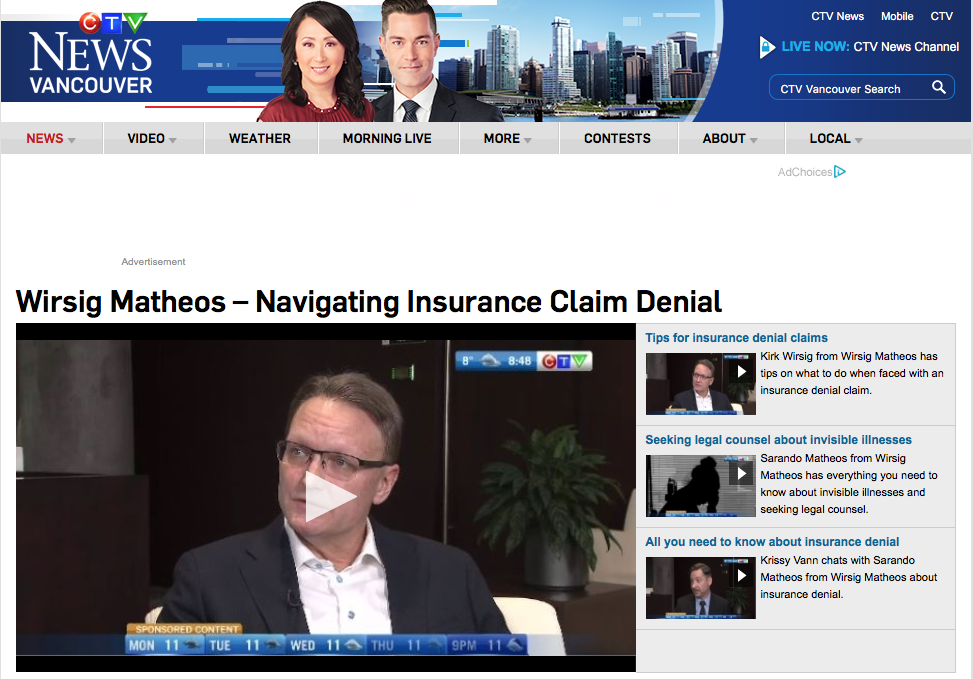
The post Wirsig Matheos Interview on CTV Morning Live appeared first on Wirsig Matheos is now part of McQuarrie.
]]>The post Disability Insurance Claim Denials: The Insurer is not Always Right appeared first on Wirsig Matheos is now part of McQuarrie.
]]>The insurance company took the position that, while the insured’s heart stopped, it was not caused by a “heart attack”. The insurer defined “heart attack” as the heart stopping due to a blockage. Since the insured’s heart stopped for an inexplicable reason and not due to a blockage, he was deemed not covered. However, the medical community would describe what occurred here as a heart attack.
Don’t Automatically Assume the Insurer’s Interpretation is Correct
We have seen similar situations to that experienced by Mr. Glennie. An insurer will often deny a claim based on its interpretation of the terms of the policy. Many people simply accept the insurer’s interpretation because, after all, they are the ones administering the policy, and they are assumed to know best. However, it is imperative to review the master policy that sets out the terms of the contract. If there is another, equally compelling interpretation that would cause benefits to be paid, that is the interpretation that should prevail. Further, if there are two equally compelling interpretations, the legal concept of contra proferentem has been used as a tie breaker.
What is Contra Proferentum?
Contra proferentem means that where a term is ambiguous, the preferred meaning should be the one that works against the interests of the party who provided the wording. In the insurance context, it’s the insurer who is responsible for drafting standard form insurance contracts. Courts acknowledge that people entering insurance contracts (including disability insurance contracts) have no negotiating power over the terms of these contracts. They accept the terms or they don’t get coverage. Courts also assume that the drafters of these documents are well aware of any limitations or ambiguities and should not be allowed to take unfair advantage of this knowledge. Similarly, if an insurer did not choose its words carefully to avoid misunderstandings, it should not be allowed to benefit from that lack of care.
So, if the normal rules of contract interpretation do not clarify which interpretation was intended by the parties, the courts may apply contra proferentem to break the tie. Some exceptions may apply if the dispute involves an argument over coverage between two insurance companies.
We have resolved many cases favourably for our clients where we have applied this legal concept.
In Mr. Glennie’s case, this legal concept was not tested as the day following the news coverage of his case, the insurance company decided to “make an exception” and pay the claim.
What to do if Your Disability Claim is Denied
When your insurance claim is denied, seek legal advice from a lawyer that has specific expertise in insurance matters. It may make the difference between getting paid or, getting nothing. If you have a question about a disability claim denial call us at 604-583-2200 for a free, no obligation consultation.
The post Disability Insurance Claim Denials: The Insurer is not Always Right appeared first on Wirsig Matheos is now part of McQuarrie.
]]>The post News of Upcoming Events appeared first on Wirsig Matheos is now part of McQuarrie.
]]>Kirk Wirsig and Martin Willemse, as counsel for the Resident Doctors of BC on insurance matters will be presenting a seminar to members of the Resident Doctors of BC on long term disability insurance coverage. Discussion topics will include what policy riders are available when purchasing an individual long term disability insurance policy, for example:
- Own Occupation rider – a rider that insures against a disability from your own occupation for the lifetime of the policy, as opposed to the usual coverage which provides long term disability coverage for a numbers of years, often two, of your own occupation and then switches to coverage for long term disability from any other occupation after the first two years of own occupation coverage;
- Future Income Option rider – a rider that allows the insured under a long term disability policy to increase the monthly benefit amount annually for a set number of years to a set maximum monthly benefit amount, without having to provide further proof of good health; and
- Cost of Living Adjusted Benefit rider – a rider that provides for periodical increases in the monthly long term disability benefit amount based on rate changes in the Consumer Price Index and other factors.
October 28, 2015: Long Term Disability Seminar – BC Psychological Association
Martin Willemse and Kirk Wirsig have been invited to present a seminar on Long Term Disability claims at an Ethics Salon hosted by the BC Psychological Association. The seminar will focus on long term disability claims based on subjective conditions, such as mental health illnesses including major depression and anxiety disorders. The opinion of treatment providers, in this instance a psychologist treating a long term disability claimant suffering from a mental health illness, is often crucial to the claim. However, a treatment provider should be wary not to be seen as an advocate, as this will influence the weight a trier of fact may give to his or her opinion.
Martin Willemse has presented papers and power point presentations on these conditions at other conferences which can be viewed here:
- Medical evidence in “invisible” conditions cases – a case law review
- Mental Health Disability Claims: Case law and Developments
The post News of Upcoming Events appeared first on Wirsig Matheos is now part of McQuarrie.
]]>The post Is my Insurance Company Delaying Approval of my Claim? appeared first on Wirsig Matheos is now part of McQuarrie.
]]>To start, make sure that you complete the form within the time required under the policy; that the form is completed properly; and, if the insurer asks for additional information, obtain that information as soon as possible.
While most insurers do not deliberately delay the process, we have heard from frustrated callers complaining that the insurance company’s agents ask for information that has already been provided, do not return phone calls, and request answers to questions that have nothing to do with the claim.
The initial decision should only take a few weeks but we have seen this initial period drag on for many, many months. In circumstances where the insurance company denies the claim, the process takes even longer as claimants attempt to appeal the decision, sometimes through multiple rounds of appeal. During this timeframe, the disabled employee is without income, getting behind financially and under added stress in dealing with the insurance company. Even more concerning, your time to take legal action continues to tick away during this entire time. This means that if your latest appeal is denied after the limitation period to sue has run out, you will likely be barred from taking legal action against the insurance company.
If your claim has been denied and the insurance company invites you to appeal, it is time to call a disability lawyer. When a disability claim is denied, we can help you decide whether it makes sense to pursue the appeal or look at your legal options.
The post Is my Insurance Company Delaying Approval of my Claim? appeared first on Wirsig Matheos is now part of McQuarrie.
]]>The post 2015 Disability Claims Management & Litigation Conference Summary appeared first on Wirsig Matheos is now part of McQuarrie.
]]>Disability claims management is a complex area and these conferences aim to keep those working in this area up to date on medical research, case law and best practices in order to better serve those suffering with disabilities and to fairly resolve disputes.
2015 Disability Claim Topics
This year’s conference focused on:
- Mental health disability claims — case law and developments;
- Changes in CPP disability legislation;
- Objective medical evidence to support claims for conditions like fibromyalgia chronic fatigue; and
- Limitation periods
We had a well-known rheumatologist speak and provided great insights on types of physical but “non-visible” disabilities such as chronic fatigue, fibromyalgia and chronic pain. These are “real” conditions and while they may rely on “subjective” evidence, our courts have accepted that people suffering with these symptoms can become severely limited in their daily function. To learn more on case law updates, read Martin Willemse’s paper on this topic.
2015 Updates to CPP Disability Appeal Procedures
Recent changes have also occurred to the CPP disability appeal procedures, such as:
- Abolishment of the 3-panel tribunal appeal
- Abolishment of the Pension Appeal Board
- Abolishment of the right to appeal to the Federal Court
- Appeal hearings conducted over the telephone without representation by Service Canada
To learn more on this topic, read Mr. Wirsig’s paper outlining these changes.
Regular and Appropriate Care of a Physician
Another important topic was defining “regular and appropriate care of a physician”. Policies differ as to where this is defined under the contract. This in turn has an impact on the rights and obligations of the insurer and claimant as to why and when insurers can expect that the claimant be under regular and appropriate care of a physician. While it seems straight forward, particular wording is subject to interpretation by the courts and has resulted in varying outcomes in litigation.
Limitation Periods on Disability Claims
Limitation periods in disability claims have always been a complicated maze to navigate. While recent legislative changes have mandated that insurers advise claimants of the existence of limitation periods, it remains a complicated area as to when the “clock begins to count down”. For example, the internal appeal process offered by the insurance company does not stop the limitation period from running. If the limitation period runs out, you may lose your right to sue.
The post 2015 Disability Claims Management & Litigation Conference Summary appeared first on Wirsig Matheos is now part of McQuarrie.
]]>The post Negotiation of Disability Claims appeared first on Wirsig Matheos is now part of McQuarrie.
]]>Know Your Bottom Line
Before you begin negotiating, figure out what your bottom line will be. That is the least you will accept in exchange for resolving the legal dispute. Never reveal your bottom line at any stage of the negotiations.
Begin your negotiations by asking for everything to which you believe you are legally entitled.
Present as many negotiable issues as you can and do not reveal their level of importance to you. That way, you can “give up” on an issue that was never really important to you to begin with. The other side will see this as a compromise and will be more willing to compromise in return.
Negotiating Without a Lawyer
If you are negotiating a legal problem without a lawyer, you should both sign an agreement first that says your negotiations are WITHOUT PREJUDICE. That means that whatever you say or write down in the process of negotiations won’t be used by either side if the matter ends up going to court.
If the negotiations fail, there are alternatives available to you other than court.
The post Negotiation of Disability Claims appeared first on Wirsig Matheos is now part of McQuarrie.
]]>The post Arbitration of Disability Claims appeared first on Wirsig Matheos is now part of McQuarrie.
]]>Arbitration often works well for commercial and business disputes.
Arbitration is more formal than mediation, but less formal than court. You and the other side agree in advance on the rules for the arbitration process (for example, what kind of evidence can be introduced, will witnesses be allowed to testify, how much time will be set aside for each side to present its case, etc).
The arbitrator listens to the evidence you each present and then makes a decision. In many cases, it is agreed beforehand that whatever the arbitrator decides is final and binding. This means you cannot have the decision reviewed or changed and must live with the outcome.
Due to the high costs of trial, the associated delays and the unexpected outcomes, in most cases, settling your case through negotiation, mediation or arbitration is preferable than risking it all and going to court.
The post Arbitration of Disability Claims appeared first on Wirsig Matheos is now part of McQuarrie.
]]>